
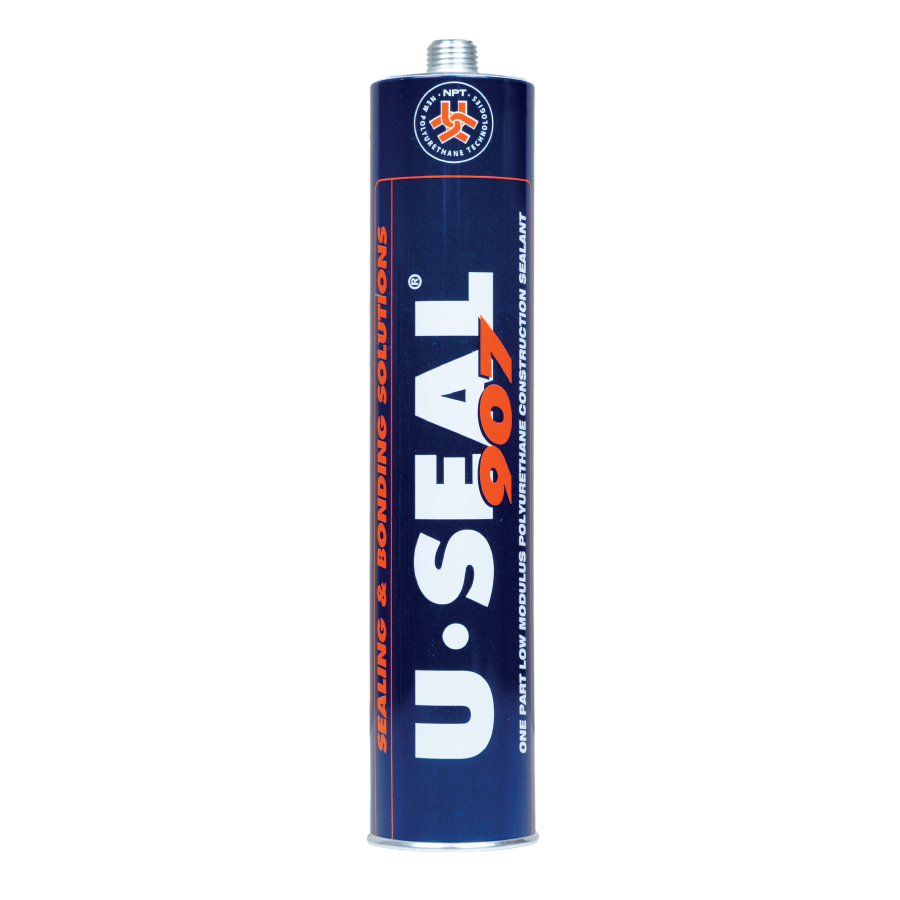
U-Seal 907 | One-Component Polyurethane Adhesive, Low Modulus, Designed for Construction
U-Seal 907 is a one-component polyurethane adhesive specifically designed for construction applications. It is easy to use and non-sagging. U-Seal 907 cures under the influence of atmospheric moisture to form a high-performance compound with permanent elasticity and excellent resistance to aging and weathering over time.
-
Simultaneous bonding and sealing
-
Permanent elasticity; adaptable to joint movement of ±50%
-
Easy to apply with excellent consistency
-
Good thixotropy, non-sagging
-
Excellent adhesion on all common construction and industrial materials without the need for a primer
-
No staining on concrete and porous materials
-
Good resistance to aging, weathering, cleaning agents, seawater, and limewater
-
Can be painted over with various water-based and solvent-based paints (preliminary testing recommended)
Application
U-Seal 907 is a versatile, high-performance adhesive and sealant for expansion joints and construction applications, both vertical and horizontal, including joints in precast elements, exterior wall joints, and cladding joints.
U-Seal 907 is suitable for sealing metal roofs and gutters, bridge railings and balconies, waterproofing joints between tiles, blocks, wood, concrete, metal, window frames, or doors, as well as sealing in water channels and general hydraulic sealing applications exposed to water.
Certifications
-
EN 15651-1/4 TYPE F INT/EXT CC/PW INT/EXT CC
-
ASTM C920 Type S Grade NS Class 50 Use T2, M, A, O, L
Compliance Standards
-
ISO 11600 Type F Class 25 sub-class LM
-
LEED iEQc 4.1; SCAQMD Rule 1168; BAAQMD Reg 8 Rule 51
TECHNICAL DATA
|
Appearance |
Non-sag thixotropic paste |
|
Color |
White, Grey, Black. Other on request |
|
Chemical nature |
Polyurethane |
|
Curing Mechanism |
Moisture-curing |
|
Curing through volume [mm] |
ca. 2 |
|
Hardness Shore A (DIN 53505) |
ca. 30 |
|
Density [g/cm3] |
ca. 1.34 |
|
Skin time [min] |
ca. 120 |
|
Elastic modulus at 100% [N/mm2] (ISO 37 DIN 53504) |
ca. 0.4 |
|
Tensile strength [N/mm2] (ISO 37 DIN 53504) |
ca. 1.5 |
|
Elongation at break [%] (ISO 37 DIN 53504) |
ca. 750 |
|
Joint movement capability (ASTM C920) |
±50 % of joint width |
|
Application temperature [°C] |
From +5 to +40 |
|
Temperature Resistance [°C] |
From -40 to +100 |
Instructions for Use
Surfaces to be bonded must be thoroughly cleaned, dry, and free from dust or grease. U-Seal 907 offers excellent adhesion without the need for primer on most common construction materials. Therefore, primer use is unnecessary if the surface is properly prepared and strengthened.
However, materials such as tiles, natural stone, plastics, coatings, and other surface treatments may make adhesion more difficult. Due to the unpredictability of these materials, preliminary testing is recommended. Precast concrete panels using release agents other than polyethylene films must be cleaned with sandblasting or mechanical abrasion, and dust must be removed.
Recommended application temperature: 15°-25°C. To make it easier to use in cold weather conditions, we recommend storing the material at around 25°C before use. To ensure the sealant moves freely in the joint, it is important that the sealant does not adhere to the bottom of the joint. Therefore, a polyethylene backer rod should be placed at the appropriate depth to create the proper joint.
If necessary, apply the appropriate primer to both sides of the joint and allow enough waiting time to avoid solvent retention. In warmer conditions, this may cause bubbling in the uncured sealant. For optimal performance, the sealant should be applied when the joint is at the midpoint of its designed expansion and contraction range. Press the sealant firmly into the joint, ensuring it fully contacts both sides of the joint and the backer rod at the bottom. Keep the nozzle in the sealant and continue with a steady flow to avoid trapping air. Avoid overlapping the sealant to eliminate the risk of trapping air.
Shaping and finishing should be done while the sealant is still tacky. U-Seal 907 can be painted over. Paint compatibility should be tested with preliminary trials. Be cautious when using alcohol or alkyd resin-based paints, as they may interfere with the curing process and extend the drying time of the paint layer. The hardness and thickness of the paint layer can reduce the sealant’s elasticity and lead to cracking.
Do not allow the sealant to cure in the presence of curing silicone sealants. Avoid contact with cleaning solvents during curing. When applying the sealant, avoid trapping air. Since the system cures with moisture, ensure adequate exposure to air.
Cleaning Instructions
Clean tools using acetone or solvent. When the sealant is uncured, it can be wiped off with paper or cloth. Once cured, removal can only be done mechanically. Avoid direct skin contact by wearing latex, rubber, or polyethylene gloves. If the sealant contacts skin, remove immediately and wash with soap and water.
Storage Instructions
U-Seal 907 can be stored for 12 months in its original (unopened) packaging at temperatures between 10°C and 25°C in a dry, cool place. The storage temperature should not exceed 25°C for extended periods. Keep away from damp areas, direct sunlight, and heat sources.
Related products
-
SiMP-Seal 55 | Multi-Purpose One-Component SiMP Adhesive & Sealant, Bonds to a Variety of Surfaces
-
SiMP-Seal 650 | Multi-Purpose One-Component SiMP Elastic Adhesive & Sealant, Completely Odorless with Very Low Emissions
-
SiMP HIGH TACK | SiMP One-Component Elastic Adhesive, High Adhesion, High Initial Bonding Strength
-
SiMP Fix Crystal | Transparent One-Component SiMP Elastic Adhesive & Sealant